
RAG As A Service
Ground every response your LLM gives in your own proprietary data — without retraining a single model. Our Retrieval-Augmented Generation implementation connects your models to authentic, up-to-date sources, so answers stay accurate, contextual, and trustworthy.
Consult Our Experts →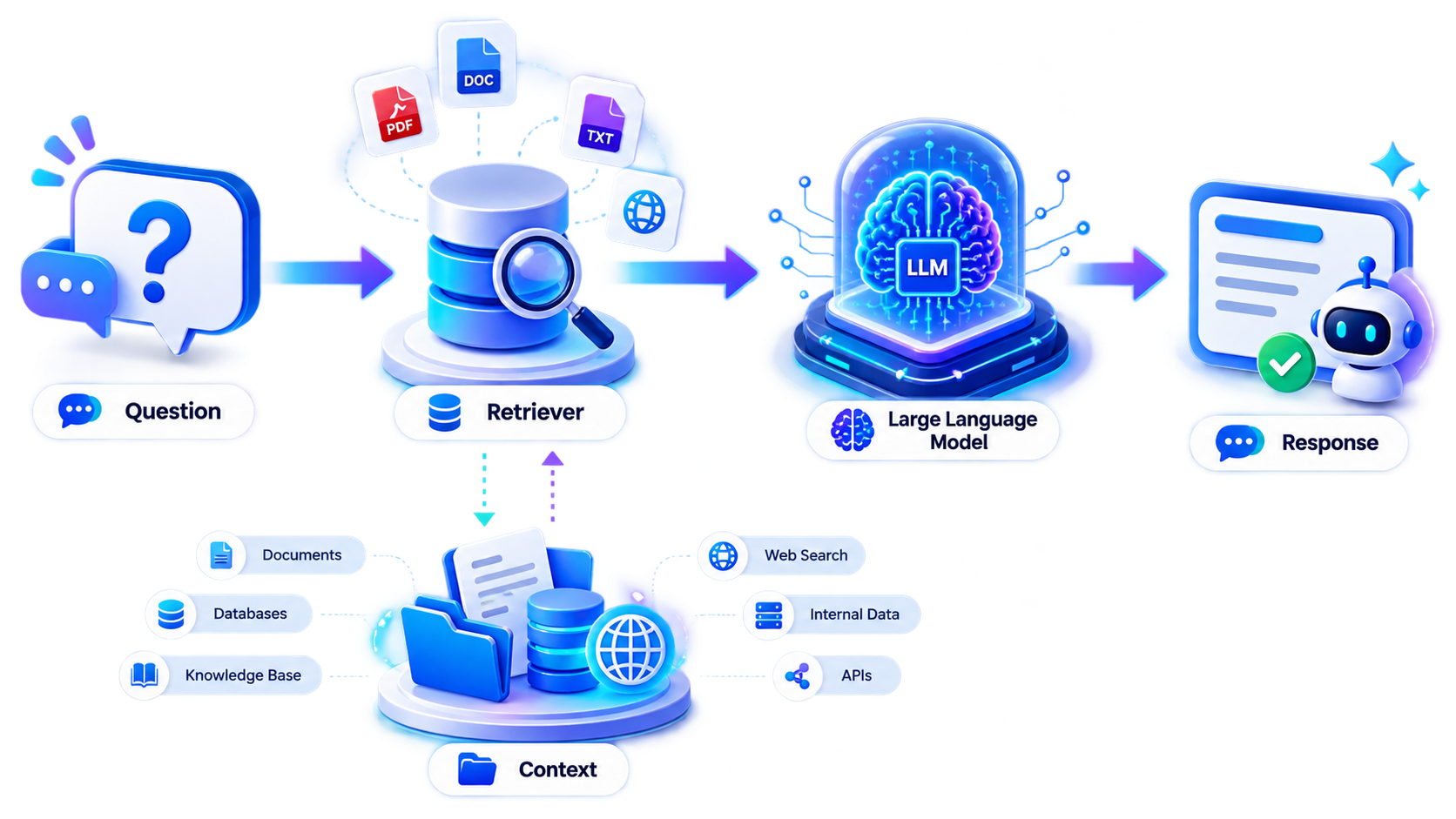
RAG as a Service to Sharpen LLM Results with Current, Verifiable Data
We fold your organization's proprietary data directly into a pre-trained LLM's context, turning static documents, inboxes, and databases into a live, conversational knowledge base your users can actually query.
Improved Accessibility
RAG lets your models draw on the freshest, most relevant data available, so teams get sharper answers and can pull company knowledge on demand — no complex queries or digging through folders required.
Enhanced Contextualization
Base LLMs only know what was publicly available at training time. We feed your proprietary or most current data straight into the model's context, so it understands and responds to what your business actually looks like today.
Prevents AI Model From Hallucinating
Trained-in knowledge goes stale fast and produces confident, wrong answers when it runs dry. RAG anchors every response to your real, retrievable data — cutting down on outdated or fabricated output.
Allows Your Model to Cite Authentic Sources
Every answer can point straight back to the document it came from, so users build trust in what they're reading and can dig deeper — useful for research briefs, reports, and internal audits alike.
Expand Your Model's Use Cases
RAG lets one model handle wildly different prompt types — from summarizing HR policy to answering questions about office amenities — by pulling in exactly the data each query needs.
Easy Upscaling & Data Updates
As your source data changes, the model finds and uses the update automatically — no retraining, no developer intervention every time a document changes.
Let Your Documents Talk Back with Accurate, Synthesized Answers
An LLM trained purely on public data has no idea what your internal policies say, how your last campaign performed, or what your customer relationships actually look like.
With RAG as a Service, your company folds internal data straight into the model — sharpening accuracy and context in every AI response, while your proprietary data stays fully under your control.
Discuss Your Project →Systematic RAG Implementation Into Your App Architecture
Say you want to compare the AI strategies of two competitors. With RAG in place, raw documents get retrieved and transformed into structured, contextually accurate answers — turning that query into something immediately actionable inside your workflow.
Requirement Identification
Data Preparation
Question Interpretation
Select Retrieval & Generative Models
Combining Models & Vector Databases
Answer Generation
Continuous Refinement
The stack we build your RAG system on
Every tool below is one our team ships with in production — pick a category to see what we use and why it's in the stack.
Hire Developers Who Optimize LLM Models for Unique Use Cases
Our team works across two RAG model types, matched to whichever fits your business challenge best.
Active RAG Model
Pulls data actively from external sources in real time, combining it with generative AI to produce content grounded in what's happening right now.
Passive RAG Model
Works from pre-compiled or predefined data sources — the better fit when real-time retrieval isn't needed and consistency matters more than freshness.
Put the Full Value of Your Data to Work with RAG as a Service
Avanzar Solution has deep experience helping clients structure and optimize their data for better use and accessibility — so we can deploy company-specific RAG solutions that bring the best of this innovation to your business.
Implement RAG →Delivering AI-driven, Industry-focused Software Solutions
Our team works closely with clients to understand their roadblocks and goals, then builds custom software solutions that are efficient and scalable across a wide range of industries.
Real Estate
FinTech
Healthcare
Logistics & Supply Chain
Streaming
Retail
Human Resource
GIS
Wellness & Fitness
On Demand
Questions teams ask us before starting
Don't see your question here? Send it over and we'll answer it directly.
RAG pairs a large language model with a live retrieval step. Instead of answering only from what it learned during training, the model first pulls relevant passages from your documents, databases, or APIs — then writes an answer grounded in that retrieved material.
A plain LLM answers from a fixed training snapshot that may be months or years old. RAG adds retrieval on top, so every answer reflects your current, proprietary data — and updating the knowledge means updating a document, not retraining a model.
Fewer hallucinations, answers grounded in your own data, citations your users can verify, and instant knowledge updates without a retraining cycle — all at a fraction of the cost of fine-tuning a model on your corpus.
Internal knowledge assistants, support bots grounded in your documentation, research and compliance summarization, contract and policy Q&A, and sales enablement tools that answer from your latest collateral.
The model receives verified source passages before it writes anything, so it composes from real content instead of guessing from stale training data. When retrieval finds nothing relevant, the system can say so rather than inventing an answer.
PDFs and Office files, SharePoint and Drive folders, wikis and Confluence spaces, SQL and NoSQL databases, CRMs, ticketing systems, email archives, and any REST API your team already maintains.
Your data stays in your cloud account or a private VPC, encrypted at rest and in transit. We map retrieval permissions to your existing access roles, so a user only ever sees answers built from documents they're already allowed to open.
A working pilot on a single data source usually takes two to four weeks. A production rollout with multiple sources, access controls, evaluation harnesses, and monitoring typically runs six to twelve weeks, depending on how clean the source data is.