
Custom LLM Integration for AI agents and applications
Bring a Large Language Model into your own product on your own terms — tuned on your data, wired in through clean APIs, and deployed wherever your compliance rules allow. The result is domain-specific intelligence, not a generic assistant.
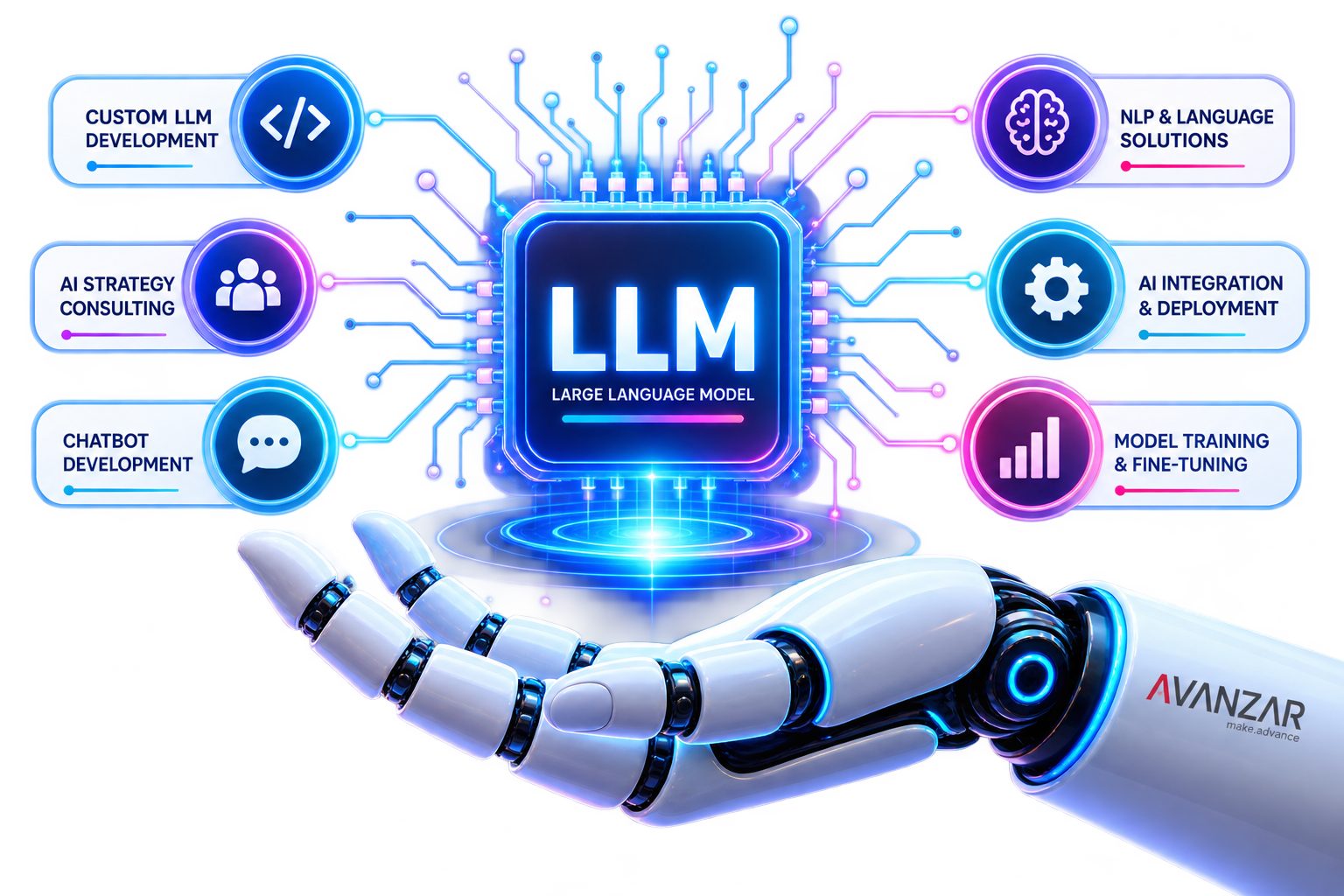
What is Custom LLM Integration?
Custom LLM Integration means embedding a tailored Large Language Model directly into your applications and AI agents. We fine-tune the model on your own data, connect it through APIs your engineers can actually work with, and deploy it for the specific jobs you need — natural language understanding, generation, extraction, and decision support.
Data preparation
Clean, de-duplicate, and label your domain dataModel selection
Hosted or open-weight, matched to the taskFine-tuning
Adapt weights, prompts, and retrieval togetherIntegration
APIs, SDKs, and agent tool bindingsDeploy & monitor
Scored on accuracy, latency, and token costTypes of custom LLM integration
Six approaches. Which one fits depends on your data sensitivity, latency budget, and how deep the model needs to sit inside your product.
Fine-tuning
Adapt a pre-trained model with your domain data so it learns your terminology, tone, and the edge cases a general model keeps getting wrong.
API wrappers
Seamless integration through RESTful APIs and SDKs, with retries, rate limiting, streaming, and cost controls already handled in the layer.
Modular plugins
Plug-and-play components for agent frameworks like LangChain or LlamaIndex, so adding a capability is enabling a module, not a rebuild.
Hybrid models
Combine several LLMs behind one interface and route each request to the right one — a small fast model for classification, a frontier model for hard reasoning.
On-premise
Self-hosted integrations with open-weight models inside your VPC or data centre, for teams whose policy says the data cannot leave the building.
Edge deployment
Quantized models running close to the user or on-device, for real-time agents where a round trip to the cloud is already too slow.
Tools, best practices & AI integration
The platforms we build on, the discipline we hold ourselves to, and how the model actually reaches your users.
Popular platforms
We build on tooling with a real production track record, and keep the integration portable enough to swap a provider without a rewrite.
Best practices
LLM features fail quietly, so we treat quality as an engineering problem with tests attached — not a vibe check the week before launch.
AI integration
A model is only useful once it reaches the right context and can act. That means retrieval, memory, and tool access wired into your stack.
Ready to integrate custom LLMs?
Tell us what your agents need to understand and do. We'll come back with a model approach, a deployment option that fits your data policy, and a realistic timeline.
Integrate Now →